Propose
A specialized planner produces candidate trajectories and makes an initial selection.
 GAC




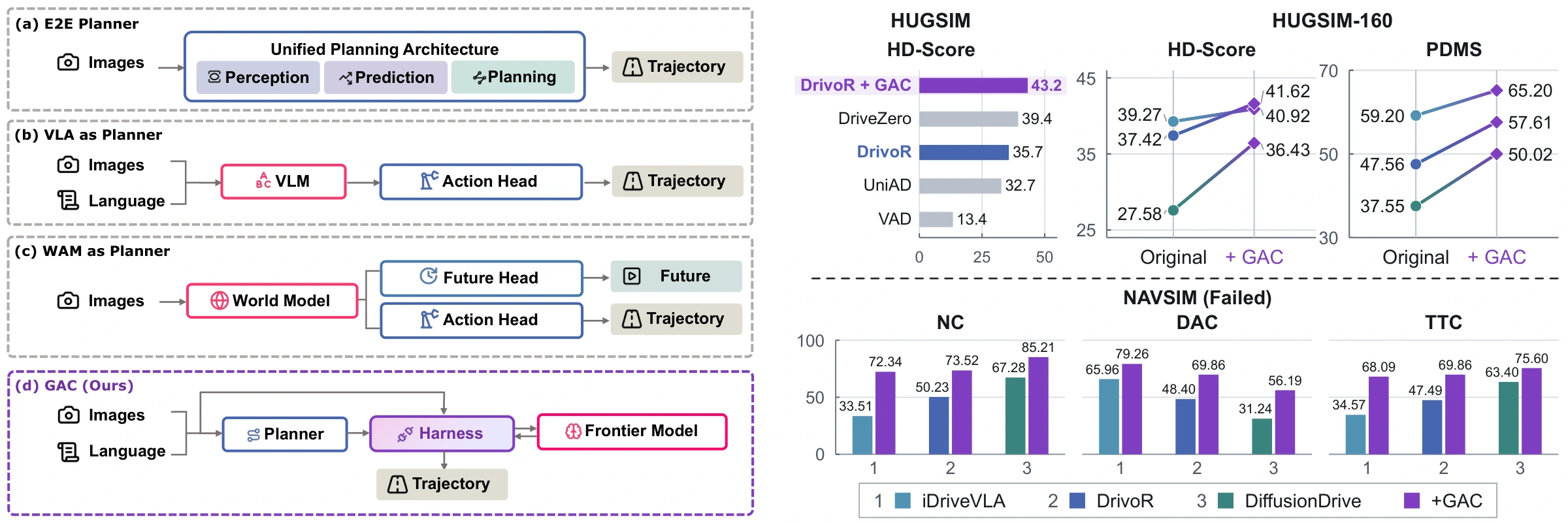
Frontier models have demonstrated remarkable general-purpose reasoning capabilities, opening new possibilities for intelligent decision making in the physical world. In autonomous driving, many recent approaches seek to leverage these capabilities through additional adaptation for action output, particularly in scenarios where existing models underperform. We introduce Generalist Action Critic (GAC), a zero-shot framework that combines frontier models’ general-purpose reasoning with the planning competence of specialized driving models through an inference-time harness. In GAC, specialized planners generate multiple candidate trajectories and make an initial selection, while a frozen frontier model serves as an action critic that assesses the selected trajectory against scene evidence and either retains it or reselects from the available candidates. The harness combines camera images with spatial overlays, provides driving context and reasoning principles through textual instructions, and regulates the information available at each stage to support trajectory assessment and reselection. On HUGSIM, GAC raises DrivoR’s HD-Score to 43.2, achieving state-of-the-art performance among methods trained without additional simulation data. GAC also consistently improves closed-loop driving safety across three planners, with relative HD-Score gains of up to 32.1%. Experiments on NAVSIM v1 further reveal how GAC improves planning performance by correcting up to 52.13% of eligible unsafe trajectory selections while introducing new failures in only 0.67% of originally high-quality selections. These results demonstrate the potential of harnessing frontier models to improve driving safety through inference-time cooperation with specialized planners.
Review the planner’s choice first, then compare candidates when reselection is needed.
A specialized planner produces candidate trajectories and makes an initial selection.
The critic reviews the selected trajectory using camera evidence, spatial overlays, and structured driving context.
Accept the original choice, or compare existing candidates after rejection and choose with a supporting reason.
Camera evidence (V), metric spatial anchors (A), and projected future occupancy (O) form a shared visual representation. The anchors and vehicle footprint are projected into the camera views and aligned with the scene.
Both stages use the same camera images and overlays of the original trajectory.
GAC improves closed-loop HD-Scores across three planners and recovers eligible open-loop failures.
Comparison on all 345 HUGSIM scenarios among methods trained without additional simulation data.
| Method | RC ↑ | HD-Score ↑ |
|---|---|---|
| LTF | 38.9 | 23.7 |
| VAD | 31.4 | 13.4 |
| UniAD | 45.9 | 32.7 |
| GigaPixel | 50.1 | 38.5 |
| DriveZero | 53.9 | 39.4 |
| DrivoR | 49.8 | 35.7 |
| DrivoR + GAC | 55.0 | 43.2 |
Recorded DiffusionDrive rollouts on HUGSIM. Original and GAC start from the same scenario.
GAC rejects a trajectory drifting toward the white sedan ahead on the right. The alternative adds modest left clearance while maintaining forward progress. Route completion increases from 20.81 to 100.
Frontier model reasoning for trajectory reselection and direct acceptance.
Recorded reasons reproduced verbatim.
By approximately 3–4 s, ego’s front reaches the lead truck’s current rear region while still moving. The closing gap across the front observations and illuminated rear lamps support slow or stopping motion. If the truck stops or remains stopped, this creates rear-end collision and TTC risk; sufficient continued movement is uncertain.
43 brakes progressively, reaching 11.93 m at 2 s and 15.70 m at 4 s, advancing only 0.245 m in the final half-second. The closing gap and illuminated truck lamps support the earlier stopping concern, although future truck motion remains uncertain. Compared with 4, it leaves about 4 m more late front clearance and reduces TTC exposure. It preserves more progress than 37 or 62, while 42 and farther-reaching alternatives offer less stopping margin for modest additional progress.
The candidate accelerates gently from rest and bends left consistently with navigation, keeping its full footprint on the driveway through 4 seconds. The lead minivan is moving away; curbside pedestrians show no clear crossing conflict. No specific issue was identified that would materially reduce PDMS or conflict with an applicable road rule.
Each snapshot compares local four-second trajectory choices, with Original above GAC.
DiffusionDrive
GAC steers away from the sidewalk corridor toward the roadway.
iDriveVLA
GAC selects stronger braking on approach to the STOP-controlled crossing.
iDriveVLA
GAC selects the left-turn branch specified by navigation.
DiffusionDrive
GAC selects a trajectory with greater lateral clearance from the lead SUV.
DrivoR
GAC selects a shorter trajectory before the construction obstacles.
iDriveVLA
GAC selects a hold before the pedestrian crossing.
iDriveVLA
GAC reselects a trajectory that yields to the oncoming sedan.
DrivoR
GAC selects a trajectory with more clearance from the curbside truck.
DiffusionDrive
GAC reselects a trajectory with greater clearance from the raised separator.
DiffusionDrive
GAC selects a turn with greater clearance from the fountain base.
DrivoR
GAC reselects a right-turn trajectory beside the parked van.
DrivoR
GAC reselects a trajectory with clearance from the splitter island.
DrivoR
GAC selects an alternative left-turn trajectory beside the parked van.
@misc{yan2026generalistactioncritic,
  title = {Generalist Action Critic: Harnessing Frontier Models in Autonomous Driving},
  author = {Yun Yan and Shizhi Hu and Zhichao Li and Yang Guan and Shiqi Liu and Jiaxin Gao and Xiangteng Zhang and Wenbo Ding and Jiuhua Zhao and Hui Guo and Xintao Yan and Keqiang Li and Shengbo Eben Li},
  year = {2026},
  eprint = {2611.27804},
  archivePrefix = {arXiv},
  primaryClass = {cs.RO},
  url = {https://arxiv.org/abs/2611.27804}
}